
The Housemaid: From Psychological Bestseller to Cinematic Thriller
A comparison of Freida McFadden's bestselling novel The Housemaid and its film adaptation starring Sydney Sweeney and Amanda Seyfried. Discover the key differences, character changes, and why each offers a unique experience.
LITERATURE
Written by: Natalia Pachón
2/28/20264 min read
The Housemaid: From Psychological Bestseller to Cinematic Thriller
In 2022, American author Freida McFadden published The Housemaid, a novel that quickly evolved from a fast-paced psychological thriller into an international publishing phenomenon. Millions of copies sold, weeks on bestseller lists, and a devoted community of readers captivated by its twists and turns turned the book into one of the most talked-about thrillers of recent years.
Three years later, the story made its way to the big screen under the direction of Paul Feig, starring Sydney Sweeney and Amanda Seyfried in the leading roles. The result is not merely an adaptation, it is a transformation that confirms how literature and cinema, even when telling the same story, can create radically different experiences.
In February of this year, The Housemaid was selected as the featured title for our book club. I must admit that it was my first encounter with McFadden's work, and my expectations were high. As an additional exercise, I decided to watch the film adaptation, which happened to be playing in theaters at the time.
My experience with both versions was, to say the least, unconventional. I began by listening to the audiobook in English through Audible and, halfway through it, went to see the movie. Afterwards, I returned to the audiobook and completed the story. Both experiences were compelling but they were certainly not identical.
The Novel: Intimacy, Manipulation, and a Fragmented Mind
The novel unfolds through two narrative voices: Millie Calloway and Nina Winchester. In the audiobook version, this distinction becomes particularly remarkable, as the narrator performs each character in a completely different manner, bringing their personalities to life and making it unmistakably clear who is speaking at any given moment.
Millie is a narrator burdened by a troubled past who accepts a position as a live-in housemaid for the Winchester family, a wealthy household whose apparent perfection feels suspicious from the very first chapter. Tension emerges immediately from a central paradox: while Millie obsessively cleans an immaculate home, her own emotional stability becomes increasingly fragile.
Nina, on the other hand, initially appears to readers and listeners as a privileged woman from high society whose sole purpose seems to be making Millie's life miserable. Yet, page after page, her layers begin to peel away. Like an onion, the novel gradually strips back each layer until we reach the core and finally encounter the real Nina.
Before becoming a full-time writer, McFadden worked as a physician specializing in brain injuries, and her understanding of human psychology is evident throughout the novel. Her storytelling relies on short chapters, strategic silences, and a constant manipulation of perspective. Readers find themselves distrusting everyone—including Millie herself—because the novel expertly employs one of the most effective devices in contemporary thrillers: the unreliable narrator.
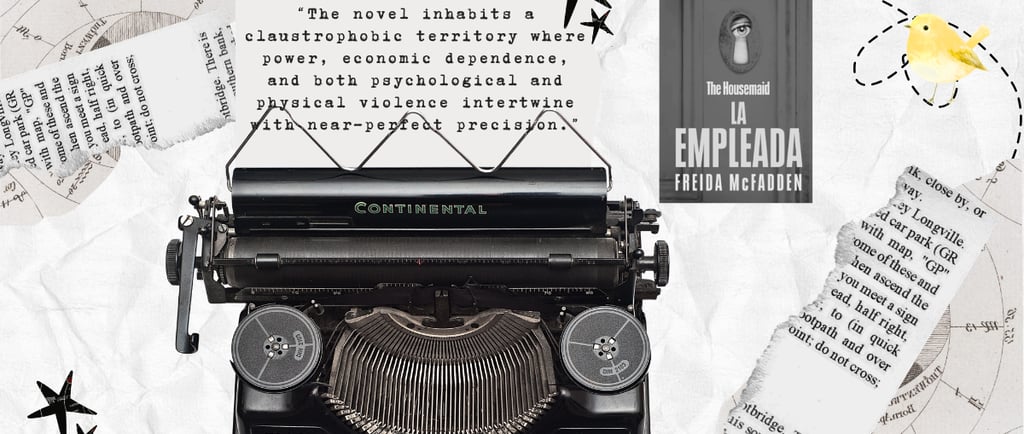
The house is more than a setting; it is a metaphor. The bedroom that cannot be locked from the inside, the small obsessions, the carefully chosen colors, and the people surrounding the main characters all reflect particular states of mind. The novel inhabits a claustrophobic territory where power, economic dependence, and both psychological and physical violence intertwine with near-perfect precision.
The Film: Visual Tension and Emotional Spectacle
The film adaptation preserves the story's basic structure: a vulnerable young woman enters a home filled with secrets. Yet the language of storytelling changes dramatically. Where the novel builds suspicion through internal thought, the film relies on glances, uncomfortable silences, and a visual aesthetic that emphasizes the contrast between luxury and menace.
Sydney Sweeney's Millie is more emotionally restrained than her literary counterpart. Her internal struggles are expressed through gestures and facial expressions rather than internal monologues. Amanda Seyfried, meanwhile, delivers a Nina who is more intense, more visible, considerably more glamorous, and ultimately less ambiguous than the character portrayed in the novel.
Cinema, inevitably, makes concessions in order to maximize visual appeal and audience engagement. From that point forward, the film condenses much of its impact through spectacle and pacing.
The rhythm changes as well. The novel carefully controls the flow of information, while the film accelerates it. Several twists are presented more explicitly, and the climax becomes more dramatic and cinematic. This choice aligns perfectly with the nature of the medium: film requires immediate visual impact, whereas a novel can sustain ambiguity for much longer because its playground is the reader's imagination.
Is It Worth Reading the Book Before Watching the Movie?
The short answer is yes—but perhaps not for the reasons you might expect.
Many film adaptations are judged according to a standard of fidelity: how closely they follow the book's plot, characters, or dialogue. In the case of The Housemaid, however, the more interesting question is not how faithful the film is, but what kind of experience each format provides.
The novel allows readers to inhabit the minds of both Millie and Nina. We share their fears, doubts, and, above all, their fragmented perception of reality. Much of the suspense comes from not knowing whether we can trust what we are imagining and feeling. It is an intimate, uncomfortable, and deeply psychological experience.
The film, by contrast, transforms that inner uncertainty into a visual and emotional journey. The settings, performances, and accelerated pacing create a different kind of tension, less introspective, but more immediate. What the novel slowly constructs in the reader's imagination, the film transforms into image, atmosphere, and spectacle.
For that reason, reading the book before watching the film allows audiences to better appreciate the adaptation choices, the character changes, and the differences in tone. It also helps explain why certain elements work differently in each medium. That said, viewers who encounter the movie first will still discover a story capable of surprising and captivating them.
Of course, readers and listeners who enjoy experimenting—as I do—may choose their own path through both versions. As I mentioned earlier, my experience with the written story was interrupted by the cinematic one. I watched the film before finishing the audiobook and, even after learning the ending through the movie, I still felt compelled to complete the novel.
And yes, the book offers nuances, details, and layers that the film simply does not have time to explore. That is precisely why I recommend experiencing both.
Perhaps the best way to approach The Housemaid is to understand that there is no definitive version. The book and the film are two doors leading into the same house. Each reveals different rooms, different secrets, and different ways of experiencing fear.
The real question, then, is not which one is better—but how willing each reader or viewer is to lose themselves in its corridors.